
You just finished your hearing test. The audiologist hands you a chart with squiggly lines, a cluster of Xs and Os, and a bunch of numbers. Your eyes glaze over. That’s completely normal. Audiograms aren’t intuitive, and most people walk out of their appointment nodding politely without really understanding what they just saw.
I’m Dr. Margaret Denison, audiologist and owner of Denison Hearing here in Arvada, CO. In this post, I’ll walk you through exactly what your hearing test results mean, so you can feel confident about what’s next. If you haven’t had a test yet and you’re wondering what to expect, start with my earlier post on what happens during a hearing test.
What is an audiogram?
An audiogram is simply a graph of what you can and can’t hear. It shows the quietest sound you can detect across a range of pitches, in each ear individually.
There are two axes to understand:
- The horizontal axis shows pitch (frequency) — low sounds on the left (like a bass drum or a man’s voice) and high sounds on the right (like a bird chirping or the letter “s” in speech).
- The vertical axis shows loudness (decibels) — quiet sounds at the top and loud sounds at the bottom.
Here’s the part that trips people up: the chart is flipped upside down from what you’d expect. Lower on the chart means the sound has to be turned up louder for you to hear it. So if your results are at the top of the graph, that means you heard quiet sounds. If they are towards the bottoms of the graph, it means sounds had to be louder before you could detect them.
What do the Xs and Os mean?
Each ear is tracked separately on the audiogram because hearing loss is ear specific.
- O = right ear
- X = left ear
You might also see < and > or [ and ] symbols. Those represent bone conduction results, which help to figure out whether your hearing loss is coming from the outer or middle ear (something often treatable or involving medical intervention) versus the inner ear (usually permanent).
The hearing loss levels and what they mean
This is the part most patients really want to understand. Audiologists categorize hearing loss based on the quietest sound you can detect, measured in decibels (dB). Here’s what each level actually feels like in real life:
| Level | Decibel Range | What it feels like |
|---|---|---|
| Normal | 0–25 dB | You can hear whispers clearly |
| Mild | 26–40 dB | You miss soft speech, especially in noisy settings |
| Moderate | 41–55 dB | Normal conversation takes effort to understand |
| Moderately severe | 56–70 dB | You miss most everyday speech |
| Severe | 71–90 dB | Only loud speech is audible |
| Profound | 91+ dB | Even loud sounds are difficult to detect |
If your results show you’re in the “mild” range, it doesn’t mean your hearing loss is unimportant, moreover, it means you’re at the earliest, most treatable stage. That’s actually the best time to come in.
The shape of your loss matters
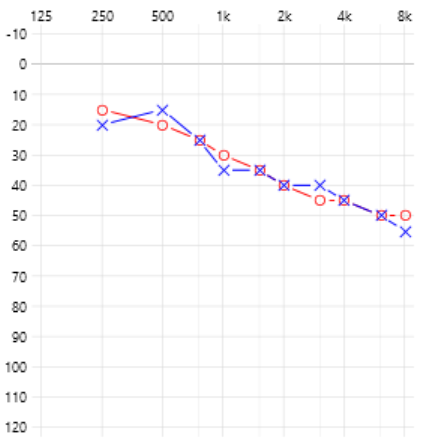
One of the most common patterns I see in my Arvada patients is called a “ski slope” hearing loss or high frequency hearing loss. A sloping hearing loss means normal or near-normal hearing in the low (bass) frequencies, dropping off sharply in the high (treble) frequencies.
With a sloping, high frequency hearing loss, patient’s report they heard what was said but they missed the beginning or end of the word. They may have misheard “cat” vs. “cap”. This is why so many patients tell me, “I can hear, I just can’t understand.” It’s not a lack of attention, it’s a specific, measurable pattern on your hearing test and it’s one of the main reasons people seek out hearing care.
What about word recognition scores?
Alongside your audiogram, you probably received a word recognition score. This score is a percentage measurement of how your brain understands sound when they are loud enough.
This number matters enormously, and it’s separate from how loud sounds need to be. A person can have excellent volume detection but poor clarity, meaning they hear that speech is happening but they can’t make out the words.
When we catch hearing loss early, word recogniton is usually good, meaning, we turn the volume up and the brain understands sound. If we wait to loud to treat hearing loss, the brain has a harder time understanding sounds, even when they are loud enough to be heard. A word recognition score is a realistic measurement of how a patient will perform with hearing aids.
So what happens next?
Based on your results, there are typically three paths forward:
If your hearing is normal, you’re in great shape. I’d recommend a baseline test every 1–3 years depending on your age, family history, and noise exposure. Keep doing what you’re doing.
If you have mild hearing loss, we’ll have a conversation about how difficult listening situations are for you in every day life. Some people with mild loss benefit enormously from hearing aids, especially in professional settings or social situations. Others do just fine with communication strategies and regular monitoring. It’s a quality-of-life question, not just a hearing question.
If you have moderate or greater hearing loss, we’ll talk about treatment options. That usually means hearing aids, but it can also include assistive listening devices, communication strategies, and sometimes a referral to an ENT if something needs medical attention first.
The hearing test is much more than the audiogram. We will discuss your individual listening scenario and cater your plan to your wants and needs to improve hearing and as a result, quality-of-life.
Have results from another clinic? I’d love to take a look.
If you’ve had a hearing test somewhere else and walked away with more questions than answers, you’re not alone. It’s one of common reasons people come to see me for a second opinion. If you have hearing aids from somwhere else and you are wondering if you can get better performance out of them, I am happy to help you.
At Denison Hearing in Arvada, I believe you should leave your appointment understanding exactly what’s going on with your hearing, what the numbers mean, what your options are, and what’s right for you specific needs.
If you’d like to sit down and go through your results together, give us a call at (303) 424-3274 or book an appointment online. I’d be happy to walk you through it.